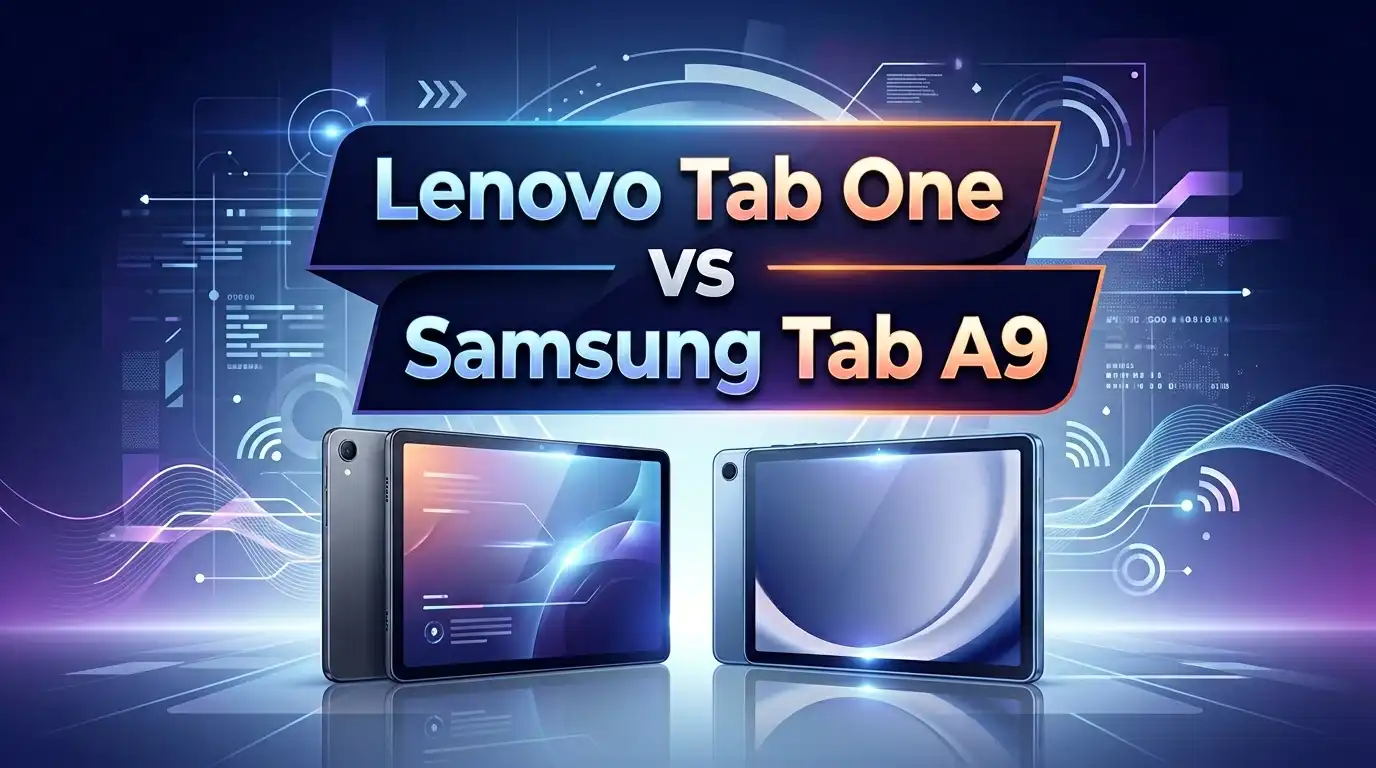
Are you torn between two of the most popular budget tablets on the market right now? You are not alone. The Lenovo Tab One and the Samsung Galaxy Tab A9 both deliver 8.7-inch displays at wallet-friendly prices.
But they are not the same tablet. One runs a newer version of Android. The other packs a faster processor. One weighs significantly less. The other offers more RAM options. These differences matter, and they can shape your daily experience with the tablet you choose.
This detailed comparison breaks down every spec, feature, and real-world performance difference between these two devices. By the end of this post, you will know exactly which tablet fits your needs, your budget, and your lifestyle. Let’s get into it.
Key Takeaways
- The Lenovo Tab One costs around $129 and ships with Android 14 out of the box. It uses the MediaTek Helio G85 chipset built on a 12nm process. It weighs just 320 grams, making it one of the lightest tablets in this price range.
- The Samsung Galaxy Tab A9 runs on the MediaTek Helio G99, which is built on a more efficient 6nm process. This gives it a clear advantage in raw processing speed. The Tab A9 also offers an 8GB RAM variant, which the Lenovo Tab One does not match.
- Both tablets feature a 5100mAh battery and 8.7-inch displays with 800×1340 resolution. Both support microSD expansion and include dual speakers. However, the Lenovo Tab One has Bluetooth 5.3 while the Tab A9 uses Bluetooth 5.1.
- The Samsung Tab A9 includes a rear camera flash, which the Lenovo Tab One lacks. The Tab A9 also weighs 366 grams, making it 46 grams heavier than its Lenovo rival.
- For software updates, the Lenovo Tab One starts ahead with Android 14. The Samsung Tab A9 launched with Android 13. Samsung typically provides longer software support, but Lenovo’s newer starting point gives it a head start.
Lenovo Tab One: Full Overview and Features

- COMPACT SIZE, COMPACT FUN – The Lenovo Tab One is compact, efficient, and provides non-stop...
- SIMPLICITY IN HAND - Add a touch of style with a modern design that’s tailor-made to fit in...

Last update on 2026-09-24 / Affiliate links / Images from Amazon Product Advertising API
The Lenovo Tab One arrived in 2025 as a compact, affordable tablet built for everyday use. It targets students, casual readers, and anyone who needs a portable screen for streaming and browsing.
This tablet runs Android 14 with Lenovo’s Zen UI 16 skin on top. The interface is clean and straightforward. You get access to the full Google Play Store with all your favorite apps ready to download.
Under the hood, the MediaTek Helio G85 processor handles daily tasks smoothly. It pairs with 4GB of LPDDR4X RAM and 64GB of eMMC 5.1 storage. You can expand the storage with a microSD card if you need more space.
Lenovo designed this tablet to be lightweight and portable. At just 320 grams, it feels easy to hold for extended reading or streaming sessions. The included folio case adds extra protection without significant bulk.
Pros:
- Extremely lightweight at just 320 grams
- Ships with Android 14 out of the box
- Bluetooth 5.3 for better wireless connectivity
- Up to 12.5 hours of YouTube streaming on a single charge
- Budget-friendly price point around $129
- Includes a folio case in the box
Cons:
- Only 4GB RAM with no higher option
- Helio G85 uses an older 12nm process
- No rear camera flash
- 64GB storage as the only configuration
- Lower download speeds compared to the Tab A9
Samsung Galaxy Tab A9: Full Overview and Features

- ATTENTION: this is the WIFI ONLY model
- Packaging contains the cell phone, a USB C to USB C cable, and a sim tray ejector tool. Seller...
Last update on 2026-08-21 / Affiliate links / Images from Amazon Product Advertising API
The Samsung Galaxy Tab A9 launched in late 2023 and has remained a strong seller in the budget tablet category. Samsung built it for families, students, and everyday users who want a reliable brand behind their device.
It ships with Android 13 and One UI 5.1, Samsung’s custom interface. One UI is well-known for its polished design and user-friendly features. Samsung’s software ecosystem also includes extras like Samsung Kids and Samsung Health.
The MediaTek Helio G99 processor powers the Tab A9. This chip uses a 6nm manufacturing process, which means better power efficiency and stronger performance compared to older chipsets. The CPU clocks higher with 2 x 2.2 GHz and 6 x 2.0 GHz cores.
Samsung offers the Tab A9 in multiple configurations. You can choose between 4GB or 8GB of RAM and between 64GB or 128GB of internal storage. This flexibility gives buyers more options to match their specific needs.
Pros:
- Faster Helio G99 processor on a 6nm node
- Available with up to 8GB RAM and 128GB storage
- Rear camera includes a flash for low-light photos
- Thinner body at just 8mm
- Samsung’s long-term software support reputation
- One UI offers a polished, familiar interface
Cons:
- Heavier at 366 grams
- Launched with older Android 13
- Bluetooth 5.1 is a step behind the Lenovo
- TFT display quality receives mixed reviews from users
- Higher-spec variants cost more
Display Quality Comparison
Both tablets share the same 8.7-inch screen size and 800 x 1340 pixel resolution. The pixel density is nearly identical on both devices. Neither tablet will deliver razor-sharp text like a premium device, but both are adequate for their price range.
The Lenovo Tab One uses an IPS TFT panel. IPS technology typically offers better viewing angles and more accurate color reproduction. Users on Reddit have noted that the Lenovo’s screen looks noticeably better in side-by-side comparisons.
The Samsung Tab A9 uses a standard TFT panel. Several reviewers have called the Tab A9’s screen its weakest feature. Colors can appear slightly washed out, and the viewing angles are not as wide as the Lenovo’s IPS display.
Both screens operate at a 60Hz refresh rate. Neither tablet supports a higher refresh rate, which is expected at this price point. For web browsing, reading, and video streaming, 60Hz works perfectly fine.
Processor and Performance
The processor is where these two tablets diverge significantly. The Samsung Tab A9’s Helio G99 outperforms the Lenovo Tab One’s Helio G85 in nearly every benchmark test.
The Helio G99 uses a 6nm manufacturing process. It features two Cortex-A76 cores clocked at 2.2 GHz and six Cortex-A55 cores at 2.0 GHz. This chip delivers roughly 10.8% faster CPU speeds than the Helio G85. The GPU is also faster, with the Mali-G57 MC2 handling graphics duties.
The Helio G85 runs on a 12nm process. Its two main cores clock at 2.0 GHz, with six efficiency cores at 1.8 GHz. The Mali-G52 MC2 GPU handles graphics. This chip is still capable for basic tasks, but it falls behind in demanding apps and games.
For everyday use like browsing, streaming, and social media, both processors perform well. The difference becomes clear during gaming or heavy multitasking. The Tab A9 handles these situations with less lag and fewer frame drops.
RAM and Storage Options
The Lenovo Tab One comes in a single configuration: 4GB of LPDDR4X RAM and 64GB of eMMC 5.1 storage. This is enough for light to moderate use. You can add more space with a microSD card, which is a welcome feature.
The Samsung Tab A9 provides more flexibility. Samsung offers a 4GB RAM / 64GB storage base model and an 8GB RAM / 128GB storage upgraded variant. The 8GB model is a strong choice for users who run multiple apps at once.
The difference in RAM matters for multitasking. With 8GB, the Tab A9 keeps more apps active in the background. You can switch between a browser, a messaging app, and a streaming service without frequent reloads.
Both tablets support microSD card expansion up to 1TB. This means you can store large media libraries, offline videos, and documents without worrying about running out of space. For most users, the expandable storage makes the base 64GB configuration livable.
Battery Life and Charging
Both tablets pack the same 5100mAh battery. This identical capacity leads to similar endurance, but real-world results vary based on processor efficiency and software optimization.
Lenovo claims the Tab One delivers up to 12.5 hours of YouTube streaming on a single charge. This is an impressive number for a budget tablet. Users on Reddit have confirmed that the battery easily lasts through a full day of light use, with some reporting up to a week between charges with minimal usage.
The Samsung Tab A9 achieved 12 hours and 18 minutes in TechAdvisor’s PCMark battery test at 200 nits brightness. Real-world battery life depends on your usage patterns. Heavy gaming drains the battery faster, while reading and browsing keep it going longer.
Both tablets support 15W charging through USB-C. Neither device supports wireless charging or ultra-fast charging speeds. Expect a full recharge to take a couple of hours with the included charger.
Camera Capabilities
Neither of these tablets will replace your smartphone camera. They both feature an 8MP rear camera and a 2MP front camera. The image quality is acceptable for document scanning, video calls, and quick snapshots.
The Samsung Tab A9 has one clear advantage: it includes a rear camera flash. This helps in low-light situations where the Lenovo Tab One’s camera would struggle. The flash also doubles as a flashlight, which is a practical addition.
The Lenovo Tab One’s camera uses a CMOS sensor. Both tablets can record video at up to 1080p resolution. The front cameras on both devices are limited to 2MP, which is enough for video calls but not ideal for selfies.
If photography is important to you, neither tablet is the right choice. However, for casual use and video conferencing, both cameras get the job done. The Samsung’s flash gives it a slight edge in versatility.
Design and Build Quality
The Lenovo Tab One prioritizes portability. It weighs just 320 grams, making it 46 grams lighter than the Samsung Tab A9. You can hold it in one hand for extended periods without fatigue. The tablet measures 8.5mm in thickness.
The Samsung Tab A9 weighs 366 grams and is slightly thinner at 8mm. Despite being heavier, the Tab A9 has a smaller overall body volume. Samsung’s design language gives it a clean, modern look that feels premium for its price.
Lenovo bundles a folio case with the Tab One. This adds value to the package and protects the tablet from scratches and minor drops right out of the box. Samsung does not include a case with the Tab A9.
Both tablets feature a metal and plastic construction. Neither device carries an IP rating for water or dust resistance. Handle both with care around liquids and extreme environments.
Audio and Connectivity
Both tablets include dual speakers for stereo sound. The Lenovo Tab One supports Dolby Atmos, which enhances the audio experience for movies and music. This gives the Lenovo a slight advantage in sound quality out of the box.
The Lenovo Tab One supports Bluetooth 5.3, the newer standard. It also supports advanced audio codecs like aptX, aptX HD, LDAC, and aptX Adaptive. These codecs deliver higher quality wireless audio through compatible headphones and speakers.
The Samsung Tab A9 uses Bluetooth 5.1. This is still a reliable wireless standard, but it lacks the latency and efficiency improvements found in Bluetooth 5.3. The Tab A9 also does not list support for the same premium audio codecs.
Both tablets include a 3.5mm headphone jack, which is a welcome feature that many premium tablets have dropped. Both support Wi-Fi 5 (802.11ac) with dual-band connectivity. The Samsung Tab A9 offers faster theoretical download and upload speeds over Wi-Fi.
Software and User Experience
The Lenovo Tab One runs Android 14 with Zen UI 16. This is a relatively clean Android skin with minimal bloatware. The interface is simple and easy to learn. Lenovo includes Google Kids Space for parents who want child-friendly content.
The Samsung Tab A9 ships with Android 13 and One UI 5.1. Samsung’s One UI is one of the most polished Android skins available. It includes features like split-screen multitasking, Samsung Kids, and Samsung Health. The software ecosystem is more feature-rich compared to Lenovo’s offering.
Samsung has a strong track record with software updates. The Tab A9 should receive at least two major Android updates and several years of security patches. Lenovo’s update commitment is less well-defined, though the Tab One already starts with the newer Android version.
For app compatibility and daily use, both tablets handle the Google Play Store without issues. The experience is smooth for social media, streaming apps, email, and web browsing on both devices.
Gaming Performance
The Samsung Tab A9 is the better choice for gaming between these two tablets. Its Helio G99 processor and Mali-G57 GPU deliver smoother frame rates in popular mobile games.
The Lenovo Tab One can handle casual games like Candy Crush, Subway Surfers, and similar titles without problems. However, demanding games like Genshin Impact or Call of Duty Mobile will require lower graphics settings and may still experience occasional stuttering.
The Tab A9’s 8GB RAM variant is especially useful for gaming. More RAM means the game stays loaded in memory. You can switch to another app and return to your game without a restart. The 4GB models on both tablets are more limited in this regard.
Neither tablet is a dedicated gaming device. If gaming is your primary use case, you should consider a more powerful tablet. For casual and moderate gaming, the Tab A9’s faster processor gives it the clear edge.
Value for Money
The Lenovo Tab One retails around $129 and includes a folio case in the box. This makes it one of the best value propositions in the budget tablet market. You get a complete package ready to use right away.
The Samsung Galaxy Tab A9 in its base 4GB/64GB configuration is priced similarly. However, the 8GB/128GB variant costs more. If you want the upgraded model, you should expect to pay a premium over the Lenovo Tab One’s price.
The Lenovo Tab One offers better value if you prioritize light weight, a better display, newer Android, and a bundled case. The Samsung Tab A9 offers better value if you need a faster processor, more RAM options, and a camera flash.
Both tablets represent excellent purchases for their respective strengths. Your ideal choice depends on which features matter most to you. Neither tablet will disappoint for basic everyday tasks like reading, streaming, and browsing.
Which Tablet Should You Buy?
Choose the Lenovo Tab One if you want the lightest possible tablet for reading and streaming. Its 320-gram weight, IPS display, Bluetooth 5.3, Dolby Atmos speakers, and bundled folio case make it ideal for on-the-go entertainment. The Android 14 software is also a plus.
Choose the Samsung Galaxy Tab A9 if you need stronger performance. The Helio G99 chip, available 8GB RAM option, and camera flash give it practical advantages. Samsung’s One UI software and reliable update schedule add extra confidence.
For students who mostly read and watch videos, the Lenovo Tab One is the smarter buy. For users who multitask frequently or play games, the Samsung Tab A9’s faster hardware will serve them better.
Both tablets are solid options under $200. You cannot go wrong with either choice for basic use. Think about your daily habits and pick the one that matches them best.
Frequently Asked Questions
Is the Lenovo Tab One better than the Samsung Tab A9 for streaming?
The Lenovo Tab One has a slight advantage for streaming. Its IPS display provides better viewing angles and more accurate colors. The Dolby Atmos speaker support adds to the audio experience. It also delivers up to 12.5 hours of YouTube streaming on a single charge.
Does the Samsung Tab A9 have a better processor than the Lenovo Tab One?
Yes. The Samsung Tab A9 uses the MediaTek Helio G99, which is built on a 6nm process. It is approximately 10.8% faster in CPU speed compared to the Lenovo Tab One’s Helio G85, which uses a 12nm process. The Tab A9 handles demanding apps and games more smoothly.
Can I expand the storage on both tablets?
Both the Lenovo Tab One and the Samsung Galaxy Tab A9 support microSD card expansion up to 1TB. This lets you add extra space for photos, videos, music, and downloaded content without replacing the internal storage.
Which tablet is lighter to carry around?
The Lenovo Tab One weighs 320 grams, which is 46 grams lighter than the Samsung Tab A9 at 366 grams. If portability and hand comfort are priorities, the Lenovo Tab One is the better option.
Do both tablets have a headphone jack?
Yes. Both the Lenovo Tab One and the Samsung Galaxy Tab A9 include a 3.5mm headphone jack. You can use wired headphones or earbuds with either tablet without needing a dongle or adapter.
Which tablet gets more software updates?
Samsung has a stronger reputation for long-term software support. The Tab A9 is expected to receive at least two major Android updates. The Lenovo Tab One starts with Android 14, which is a newer version, but Lenovo’s long-term update commitment is less certain.

Hi, I’m Sam! I’ve been passionate about technology for over a decade, fascinated by how innovative devices can transform our daily lives. As the founder of DeviceDiary.blog, I spend my days testing the latest gadgets, exploring AI innovations, and translating complex tech specs into practical insights.